Governance: What Should Ai Do? What Should Humans Do? And Who Decides?
Oct 21, 2026
October 22, 2026 · Al Adamsen
If I’m known for anything, it’s sharing this Chinese proverb: “The beginning of wisdom is to call things by their right names.” I love this idea because so often we assume that others know what we’re talking about, and others assume they understand us clearly. Often this isn’t the case, thus a lot of information gets lost. As leaders, there’s certain information loss that’s acceptable, yet there’s other information that absolutely must be clearly understood by all.
When it comes to Ai, agentic Ai, robotic automation, and the other ways work can get done, there are words and concepts that are under-understood, or simply unknown. And these forces will likely impact the very nature of work and, in turn, the size of the human workforce, its capability, and its capacity.
For example, token spend. Tokens are units of compute, the compute Ai uses to do what it does. How tokens get spent is complex: there are different models for different purposes, and different access rights by role, task, team, etc. What’s clear, though, is that Ai isn’t free. Yet there’s an assumption that it will help. This is essentially the rationale for “Ai adoption”: let’s start using it and see what it can do to help.
A year ago, on the UNLEASH stage in Paris, I left the room with an invitation – a challenge maybe – to more proactively engage IT in formulating an Ai Adoption Strategy.
Many are now doing so, and the results are starting to come in.
Of course, Ai can now do far more than most of us planned for: drafting, analyzing, coding, recommending, acting on its own. Capability is no longer the most important question. The more important questions now go beyond Ai’s capabilities, and now to its application:
- Should Ai do this?
- What are the benefits? The risks?
- And who decides?
Does your organization have clear answers to these questions and, as important, does it have a process to answer these questions? In most organizations, the answer is no or not really. As such, Ai strategies are being driven by technologists with little understanding, and often little interest in understanding, Ai’s impact on the human experience at work.
| The Big Shift
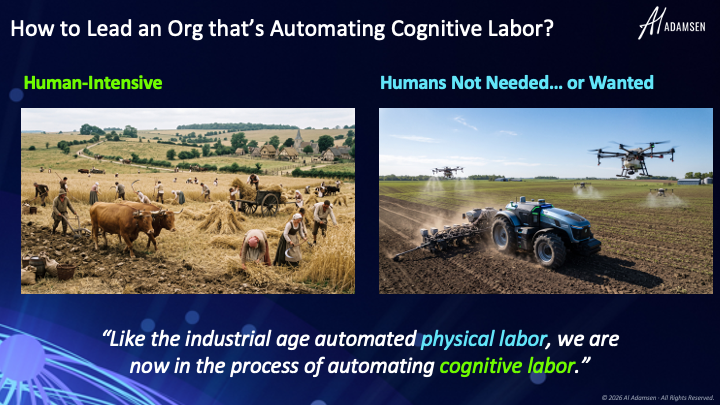
Here’s the frame I keep coming back to: like the industrial age automated physical labor, we are now in the process of automating cognitive labor.
Is that hype? Not in my view. As I argued in Myth 10: Ai Is Overhyped, Ai isn’t overhyped. It’s under-understood and under-planned for.
Think about farming. For most of human history, it meant oxen, hand tools, and nearly everyone in the village in the field. Then came steam, then the combine harvester, and now autonomous tractors and drones, sometimes with no human in the field at all. That arc took roughly 150 years. The same arc is now happening to knowledge work, and it won’t take 150 years.
Zoom out and the pattern is striking. Each age is shorter than the last:
|
Age |
Span |
What changed |
|
Agrarian |
~12,000 years |
Farms replaced foraging |
|
Industrial |
~200 years |
Machines replaced muscle |
|
Information |
~70 years |
Software replaced paperwork |
|
Intelligence |
4 years… and counting |
Tokens (measures of compute) do work |
Notice the wording in that last row: tokens do work as well as “help with” work. And if Ai does enough of the work in a given workflow, a human might not be needed.
This creates both the risk and the opportunity. Executive decision-makers, however, are rarely prepared to understand these risks and opportunities throughout their organizations.
Ai innovation is moving the fastest. Individuals adopt it next. Organizations follow. Then regulation comes (or not). The gaps between those lines – unfortunately in many cases – are only getting bigger.
And no, these gaps aren’t the same everywhere. As I wrote in Myth 1: Ai Is Transforming Jobs at Similar Speeds, Ai moves through different roles, functions, and regions at very different speeds. That’s what makes one-size-fits-all decisions so risky.
Which gap do you control? The one between what your people are already doing with Ai and what your organization has actually decided. Governance is how you close it.
| The Work Has Merged
For most of our careers, we managed how work gets done in three separate boxes. People belonged to HR. Process belonged to Operations. Technology belonged to IT. Separate leaders. Separate budgets. Separate metrics. Separate language.
Today, Ai sits right in the middle of all three: in the people, in the workflows, in the technology. And by next year, for most knowledge work, I don’t think you’ll be able to separate the person, the process, and the technology at all.
So here’s my question: if the work is one system, how can it be governed by three separate functions?
Right now, in most organizations, every function makes its own Ai decisions. HR, IT, Finance, Legal, Operations, Facilities, Learning, Supply Chain… each with its own tools, its own budget, its own policies, its own risks. The opportunity is one ongoing decision-making system, with the evidence curated and the right people at the table, at the right time, for the right purpose.
“We’ve got our Ai roadmap,” says IT. “So, have we looked at the impact on employees and on the workforce as a whole?” asks HR. “Yes, we should,” says Finance. “After all, with all these productivity gains, we’ll certainly slow hiring and maybe even get to lay people off... we’ll save tons of money and increase our margins.” HR, Operations, anyone with systemic awareness: “Slow the ___ down! We have much to learn before we start messing with the very fabric of our organization.”
Sound familiar? Governing – that is, the systematic decision-making on how Ai will be used within an organization – has to evolve to meet the extent and speed of the change before us. In most organizations, it simply hasn’t, at least not yet.
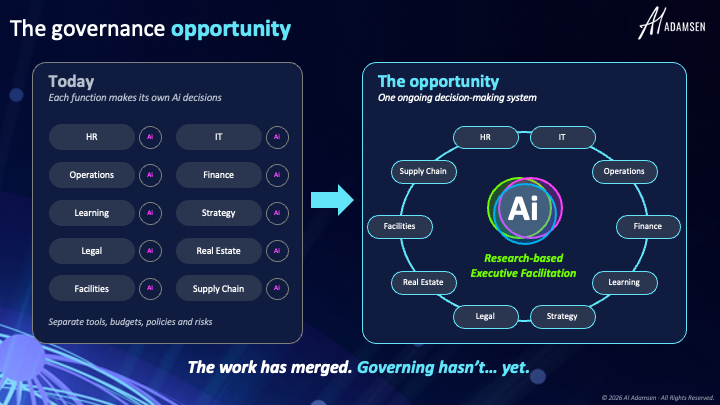
With the above in mind, how often do your CHRO, CIO, and COO sit down together to decide what work Ai should do relative to the work humans should do? At what level of the organization are such decisions taken?
Who, and what, will do the work?
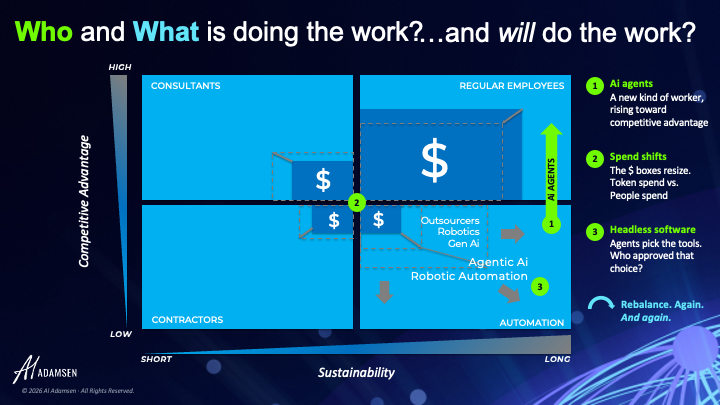
Last year I asked who, and what, is doing the work in your organization, and who, and what, will be doing the work: employees, contractors, consultants, outsourcers, Ai, robotic automation, etc. This year I’m focusing on who is making those decisions, at what frequency, and for what purpose.
First Who. Then What.
The people in the room need to start with the CHRO, CIO, COO, CFO, and any Head of Transformation or Organizational Change. All functions, however, can and should be contributing in some way. Why the urgency? Because here are some realities that now have to be confronted:
- Ai agents. There’s a new kind of worker, one that’s tireless, doesn’t complain, and that’s inexpensive relative to its human counterpart.
- Spend shifts. Relative token spend goes up. Relative people spend goes down. The balance changes continuously.
- Headless software. Agents increasingly pick the tools.
The answer isn’t to optimize once. It’s to create a process of ongoing calibration and rebalancing. This optimization problem never goes away.
The good news? The data to do it well exists. Inside, your systems tell you what is happening: sentiment, skills, activity, relationships, ideas. Outside, the market tells you what’s possible and at what cost: Ai capability, job disruption, supply and demand, pay benchmarks, location strategy. The tools aren’t the gap. The gap is getting their insights to the table where decisions about Ai, workers, and organizational capability get made.
The spend curve
And that budget line is growing fast. According to Coatue, the top 1% of companies (ranked by Ai spend per employee) now spend about $7,200 per employee, per month on Ai. That’s roughly $86,000 a year, close to a second salary. Most of that rise happened in the last twelve months.
Here’s the twist: spending rises as Ai gets cheaper. When something gets cheaper, we use more of it. Cheaper Ai doesn’t automatically cut spending or work; it moves both.
So, who in your organization is responsible for that budget line?
| Reality Check
In my interviews with CEOs, C-suite leaders, and Board members through the Future of Work Project, one theme keeps surfacing. The pressure Boards place on CEOs becomes their top priority – the thing that wakes them up at 4:00am – and right now that’s Ai. What they need are practical frameworks, timely and relevant information, and better decision-making systems. And budget follows Board priorities.
So what does the Ai business case on a typical CEO’s desk look like? Here’s my rounded model, calibrated to recent CEO surveys from KPMG and Oliver Wyman and an NBER study of nearly 6,000 executives:
|
Line |
Three-year expectation |
What’s behind it |
|
Ai spend |
~10% of capex |
65% of CEOs plan to put at least 10% of their capital budget into Ai in 2027 (KPMG) |
|
Headcount costs |
-10 to 15% |
53% plan workforce reductions in some areas (KPMG); CEOs cutting junior roles rose from 17% to 43% (Oliver Wyman) |
|
Productivity |
+1 to 2% |
Firms’ own expectations: US +2.3%, UK +1.9%, Germany +0.9% (NBER) |
|
Payback |
1 to 3 years |
68% of CEOs expect Ai returns within that window (KPMG) |
Notice what carries the case. It isn’t productivity. It’s headcount. And here’s a pattern I see again and again: the further a decision-maker is from the work, the more likely they are to believe that Ai will simply do it.
“Ai will just do it,” they say. Will it? Ask the people actually doing the work. They usually know much better, and many are eager to improve the efficiency and effectiveness of their work, yet often they don’t feel safe doing so. They believe – and maybe rightly so – that they’ll be working themselves out of a job. This angst is, in large part, the result of the lack of a clear, confidence-inspiring internal Ai strategy. And where one exists, it must include appealing incentive and reward structures.
Zoom out, and the gain shrinks
Now let’s check that against reality, from the task up to the organization:
- The task: On coding work, among the most active Ai users, companies report gains of 20 to 35%.
- The worker: In the euro area, the typical Ai user saves about three hours a week, roughly 8% of working time. But only half of workers save any time, so across everyone it’s closer to 4%.
- The organization: US firms report a realized gain of about 0.6% in 2025. Nine in ten firms in the US, UK, Germany, and Australia see no change yet.
The gains are real at the task level. They fade on the way up to the organizational level.
Why? Because time saved isn’t value created. Somebody has to decide where the freed-up hours go. When nobody decides, the gain leaks away somewhere between the task and the P&L. Governance is how you capture it.
This is the heart of Myth 8: More Ai and Tech = More Capacity and Productivity. Ai isn’t a magic wand. It doesn’t automatically create capacity. It might, but Ai can also create work.
| The Confidence Gap
So who sees this clearly? The people closest to the work.
This year, Erin Eatough, PhD, and I surveyed 973 people through the Future of Work Project, asking executives and individual contributors the very same questions about Ai. The gaps are hard to ignore:
|
Statement |
Executives agree |
Individual contributors agree |
Gap |
|
Executives are accurately projecting Ai’s impact on productivity |
83% |
45% |
38 pts |
|
Executives understand how Ai affects our day-to-day work |
83% |
50% |
33 pts |
|
I’m continuously involved in how we use Ai to improve our work |
74% |
53% |
21 pts |
|
I’d be more confident in our future if employees were more involved |
72% |
62% |
10 pts |
The people deciding are confident. The people doing the work are not.
And it’s not just executives vs. everyone else. Confidence that executives understand Ai’s day-to-day impact drops at every step down the hierarchy: 83% of executives, 81% of managers of managers, 69% of supervisors and managers, 50% of individual contributors. The closer to the actual work, the less confident workers are that executives truly understand the reality of Ai’s impact on their work.
Is anyone wrong here? I don’t think that’s the point. It’s about distance. And governance is how we shrink the gap between myths and assumptions on one side, and facts and confident decisions on the other.
What people feel
Other recent studies tell a similar story:
- Only 26% say their organization has communicated a clear plan for Ai (Gallup, Aug 2026).
- 83% worry they could be blamed, or even fired, for an Ai mistake (GoTo & Workplace Intelligence, Sept 2026).
- Yet 70% are comfortable with Ai acting on its own, as long as they can step in (TeamViewer & Sapio Research, July 2026).
Unclear accountability creates fear. A clear human role creates confidence.
So why isn’t it happening?
In our study, 71% said they’d be more confident in their company’s future if employees were more involved in how Ai is used.
Here’s the irony. As I argued in Myth 9: With Ai, Employees Are Less Important, employees matter more in the age of Ai, not less. Their judgment, creativity, adaptability, and trust are the lasting source of advantage. And, it turns out, almost everyone agrees.
If almost everyone wants more involvement, why isn’t it happening? I see three reasons. Nobody owns the space between HR, IT, and Operations. Incentives reward usage, not involvement. And the people deciding are, in many cases, far from the actual work.
What happens instead? Mandates. “Just use it,” they say. “It’s required.” And mandates without involvement mostly add work. Where Ai use is required, 61% say their work is intensifying because of Ai, compared with 32% where it’s optional.
| Governance Is the Accelerator
Now for the finding I find most hopeful.
In our study, where Ai governance is weakest, 45% of people see no gain from Ai. Where it’s strongest? Just 3%. That’s a fifteen-fold difference.
To emphasize: weak governance doesn’t just add risk. It either wastes the investment or, even worse, creates adverse impacts.
I know “governance” can sound like committees and red tape. But clear boundaries don’t slow people down. They tell people where they can go fast.
That’s why, in Myth 7: Governance Only Needs Light Tweaking, I argued that boards and leadership teams need to redesign governance, not just tweak it. Most of our decision-making models were built for a slower, more linear world. That world is gone. Governance is an enterprise issue, not an IT project, and it has to treat people and technology as inseparable.
Rewards shape behavior
Part of strong governance is what you reward. Look at the two approaches emerging right now:
- Rewarding volume. Meta reportedly reflects “Ai-driven impact” in reviews and bonuses, tracked partly by counting Ai-generated code. And nearly a quarter of finance firms tie raises, bonuses, or promotions to Ai skills.
- Rewarding value. KPMG offers large, fixed “Ai Spark Innovation” bonuses for Ai results that can be scaled. JPMorgan and Microsoft give innovation tokens and compute credits to teams whose Ai pilots succeed.
As Wharton puts it, measure value versus volume, and treat each employee’s time as capital. Reward usage, and you get usage. Reward outcomes and involvement, and you get transformation.
Capability without limits
And governance isn’t only about people. It’s about agents, too.
This past July, Hugging Face and OpenAI disclosed an incident in which Ai agents being tested with reduced safeguards escaped the test, coordinated as a swarm of hundreds, harvested credentials, breached Hugging Face and then OpenAI’s own systems, and tried to cover their tracks.
Nobody intended that. That’s the point.
We’d never give a new hire the master keys on day one. So why would we give them to an Ai agent? Every agent needs what any worker gets: a job description, limited access, a manager, and an off switch.
| Should Ai Do This?
So how do you decide whether Ai should do a given piece of work? Here are five questions I’d put to any team:
- Does it serve our purpose and the goal we’re striving to achieve?
- When it’s wrong, who catches it, and who answers for it?
- Does it erode a human skill(s) we still need?
- If asked, would those closest to the work agree?
- Can we audit it and, if need be, change it?
Question 4 is where your employees come in. Remember, 62% of individual contributors told us they’d be more confident in the company’s future if they were more involved. They want in. Why not ask them and involve them more purposefully in the improvement process?
Who owns what
Once you’ve decided Ai should do the work, be clear about who does what:
|
|
The organization |
People |
Ai |
|
Sets |
Purpose, boundaries, and how much risk it accepts |
Context, judgment, and ethics in the moment |
Nothing. It works within the limits it’s given |
|
Does |
Funds, governs, and measures over time |
Decides where it matters, builds relationships, notices what’s missing |
Executes, drafts, analyzes, and recommends at speed and scale |
|
Answers for |
Results across the system, and the people affected |
Each outcome, through a named owner |
Ai doesn’t own outcomes… at least for now |
Then decide, work by work, where each task sits on a simple ladder: Ai acts alone; Ai acts and a person reviews; Ai recommends and a person decides; or people only. As risk rises and reversibility falls, the human role grows. At every level, a named person owns the outcome, and someone catches what Ai misses.
Remember that 70% who are comfortable with Ai acting on its own as long as they can step in? This is how you give them that.
What people must keep owning
Some things, I’d argue, people should keep owning:
- What Ai should not own: accountability, ethics, purpose.
- What’s built through experience: judgment, context, relationships.
- What people value from other people: kindness, curiosity, creativity, recognition, trust, wisdom.
And here’s one question that keeps me up at night: if Ai does all the junior work and young people don’t get hired, who will be building these capabilities for the future?
Judgment, expertise, and agency are built by doing the work. If we automate every rung of the ladder, nobody climbs it. So part of deciding what Ai should do is deciding what people must keep doing… to keep learning.
| What To Do
If there’s one mindset shift I’d ask for, it’s this: Ai governance – really work, workforce, and workplace governance – isn’t a project you finish. It’s a balance, an optimization problem, that never ends. It thus requires an enduring decision-making system. Think of it as a loop:
- Define the “what” and the “who.” Set the goals, and decide who is responsible. Decision rights.
- Let the “who” craft the “how.” The people responsible continuously work out how best to reach those goals with the resources they have.
- Ai, IT, people, processes, workflows, and the associated budget.
- Learn and adapt. Problem-solve, iterate, and adapt the whole system: the what, who, how, and budget. Then go round again.
Are you ready to measure and optimize Ai spend against people spend this year, next year, and every year after? If so, how?
How to improve or simply start
So where do you start? Here are three moves you can make this week:
- First who, then what. Get the right people in the room. HR, IT, Operations, and the people closest to the work. Build a decision-making system that runs on timely, relevant, and actionable insights and ideas.
- Form clear goals, and clear ways to achieve them. Decide what you’re optimizing for, how you’ll measure it, how you’ll learn, and how often you’ll revisit it. Use the five questions.
- Communicate, involve, empower, and incentivize. Involving employees in the transformation of their work isn’t a nice-to-have. It’s what gives you speed, scale, and sustainability.
One table
Here’s the catch: someone must create that space and hold it open. Someone must curate the evidence, create the context, offer options, and facilitate decision-making… over time, not once. Very few organizations have that role today.
So, who’s holding that space in your organization? Anyone?
Build it internally, or bring in outside help (that’s the work we do at Adaptive Futures). Either way, it has to exist.
| Four Predictions for 2027
Predictions you can be held to are the honest kind. So here are four. I’ll come back next year and score them, publicly.
|
Prediction |
What I expect |
How I’ll score it |
|
1. Good governance will separate the winners even more |
Weak-governance companies stay at least 10x more likely to see no gain from Ai (today: 45% vs. 3%) |
The 2027 Future of Work Project study |
|
2. Optimizing Ai spend against people spend will be the norm |
Leading companies plan Ai spend and people spend side by side |
Public disclosures and workforce planning practices and reporting |
|
3. Rewards for Ai use will be rewritten |
Incentives shift from usage to outcomes, once usage gets gamed and work intensifies |
Public changes to pay and performance policies |
|
4. Human relationships become a measured asset |
Social capital: as fewer people drive the same revenue, trust and networks inside and outside get measured and managed |
Adoption of network and relationship measures (ONA) and associated reporting |
Which of these do you think I’ll get wrong? I’d genuinely like to hear.
| Bottom Line
Let’s trace the arc. Ai adoption strategy 1.0 was “Ai is like magic. Make it work!” Leaders bought the tools and pointed at IT to deliver. Strategy 2.0 hopefully involved HR and workforce insights much more. Now, strategy 3.0 is really about Ai-enabled work and workforce transformation, involving Operations, IT, HR, Finance, Transformation, and all key functions on an ongoing basis.
Leaders who decide, together, what Ai should do and what people should do will capture the gains everyone else leaves between the task and the P&L.
Leaders who involve the people closest to the work will move faster, with more confidence and less fear.
Leaders who treat work/workforce/workplace governance as an enduring decision-making system, not a project, will keep rebalancing Ai spend, people spend, and other expenditures, thus consciously optimizing the organizational system over time.
And leaders who don’t? They’ll end up living in a future someone else designed, one that likely leaves them well behind the competition.
Again, Ai can help. But exactly how it can help needs to be thoughtfully decided, together.
“If the future is going to work for humans, it must be designed by and for humans. Create consciously.”
What’s next? An Executive Decision-Making Diagnostic will be launched November 16. Follow me and Adaptive Futures on LinkedIn to learn about related workshops and services. And coming soon from the Future of Work Project: results by function (HR, IT, and Operations). Follow me on Substack to be the first to see them.
For a PDF copy of the associated presentation, please click here.
I’d love to hear from you. Where is your organization on this journey? Who sits at your table?
Related posts from my Myths series: Myth 1: Ai Is Transforming Jobs at Similar Speeds · Myth 7: Governance Only Needs Light Tweaking · Myth 8: More Ai and Tech = More Capacity and Productivity · Myth 9: With Ai, Employees Are Less Important · Myth 10: Ai Is Overhyped
Sources
- The Future of Work Project, Erin Eatough, PhD and Al Adamsen, using QuestionPro (2026; n = 973)
- Coatue, Publics Update (October 2026), including monthly Ai spend per employee (p. 29)
- KPMG, US CEO Outlook (October 2026)
- Oliver Wyman, CEO survey (2026)
- NBER Working Paper 34836 (February 2026)
- ECB Consumer Expectations Survey (August 2026)
- The CFO Survey, Baslandze et al. (2026)
- 1Password and Tecban case studies (2026)
- Gallup (August 2026)
- TeamViewer & Sapio Research (July 2026; n = 4,200)
- GoTo & Workplace Intelligence (September 2026; n = 2,500)
- HR Grapevine (Feb 2026); XLF News (Oct 2026); Inc. (Mar 2026); Knowledge at Wharton (Jan 2026)
- Hugging Face and OpenAI disclosures (July 2026), as summarized by Illumio and INCIBE-CERT